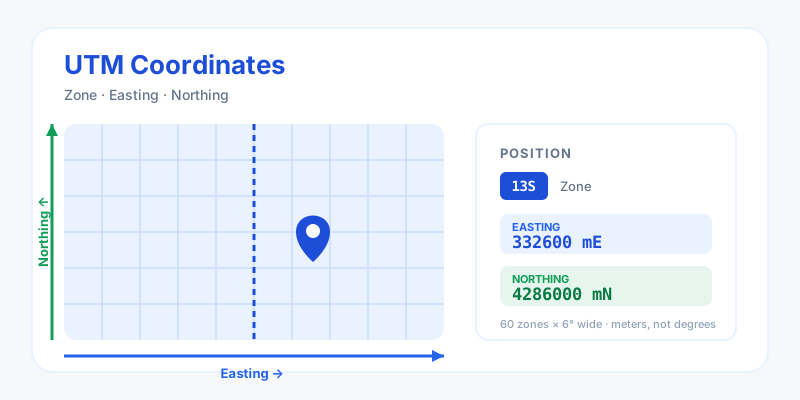
If you have ever stared at a topographic map and seen numbers like 13S 332600E 4286000N, you have met the UTM coordinate system. UTM (Universal Transverse Mercator) describes positions in plain meters instead of degrees, which makes it a favorite of surveyors, hikers, and GIS professionals. Here is what those numbers actually mean and when you should reach for them.
What UTM coordinates are
UTM is a global grid that flattens the round Earth into a series of manageable, low-distortion strips. Instead of angular degrees of latitude and longitude, it gives you a flat, metric position: how far east and how far north you are within a given slice of the planet. Because everything is measured in meters, you can calculate distances, bearings, and areas with simple arithmetic rather than spherical trigonometry.
A complete UTM coordinate always has three parts working together:
- Zone — which slice of the world you are in (for example, 13S)
- Easting — how far east, in meters
- Northing — how far north, in meters
Leave out the zone and the easting/northing are ambiguous — the same pair of numbers repeats in every zone around the globe.
UTM zones: slicing up the Earth
The system divides the world into 60 zones, each 6 degrees of longitude wide. Zones are numbered 1 to 60 starting at the 180° meridian (the international date line) and counting eastward. Coverage runs from 80° S to 84° N; the poles use a separate polar system instead.
Most of the continental United States falls in zones 10 through 19. Each zone is also tagged with a latitude-band letter (C through X, skipping I and O) that spans 8 degrees of latitude. So a label like 13S pins you to one specific rectangle of the global grid before you even look at the meter values.
Easting and northing: reading the meters
Within a zone, your exact spot is given as two distances in meters. By convention, easting is always stated first, then northing.
| Value | Measured from | Key reference |
|---|---|---|
| Easting (east–west) | The zone's central meridian | The central line is assigned 500,000 m (a "false easting") to avoid negative numbers |
| Northing (south–north) | The equator | Equator = 0 m in the north; in the south it is set to 10,000,000 m |
The false-easting trick has a handy side effect: if your easting is greater than 500,000 you are east of the zone's center line, and if it is less you are west of it. Read easting left-to-right first, then northing bottom-to-top — exactly like reading the grid squares on a paper map.
When surveyors and pros prefer UTM
Neither UTM nor latitude/longitude is "more accurate" — they are just two languages for the same point. The right choice depends on the job:
- Latitude/longitude shines for global navigation, aviation, and marine charts, where you cross many zones. If you want your everyday position in degrees, our find my current coordinates tool shows it instantly.
- UTM shines for local, metric work — surveying, civil engineering, construction, and regional mapping — because distortion stays tiny inside a 6-degree zone, so straight-line distances and areas in meters are reliable.
The military uses its own flavor of this grid called MGRS (Military Grid Reference System), which packs the zone, a 100 km square ID, and easting/northing into one compact string.
Converting to and from UTM
You rarely compute UTM by hand. To turn degrees into a zone with easting and northing, use our latitude and longitude to UTM converter; to move between any formats at once, the all-in-one coordinate converter handles UTM, decimal degrees, DMS, and Plus Codes together.
A few practical pointers:
- Always record the zone alongside the easting/northing, or the location is useless elsewhere.
- Need degrees in minutes and seconds instead? The decimal-to-DMS converter reformats lat/long for navigation.
- Measuring across two points? Convert both to lat/long and use the distance between two coordinates calculator for a quick check.
Once you internalize the three-part structure — zone, then easting, then northing — UTM stops looking cryptic and starts looking like what it is: a clean, metric address for any point on Earth.