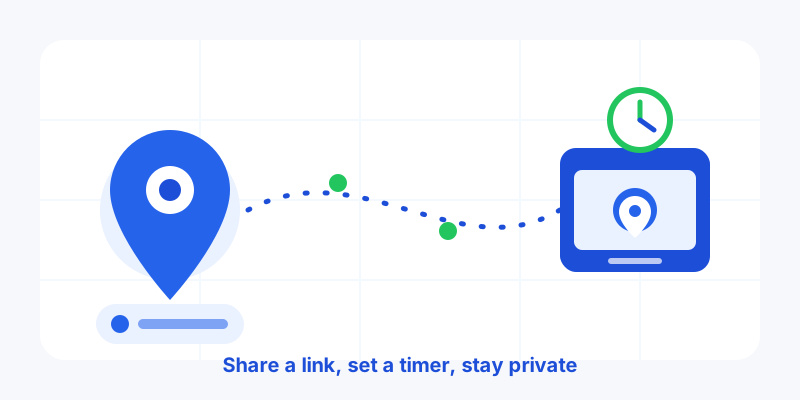
Telling a friend "I'm five minutes away" is easy. Showing them exactly where you are without handing a stranger a map to your front door takes a little more thought. Sharing your location safely comes down to a few choices: what you share, with whom, and how. Here is link-based sharing, when live tracking is the better tool, and the privacy habits that keep your whereabouts from leaking.
Link-based sharing: the simple, low-risk option
A location link is a snapshot. It captures where you are (or a place you want to point to) and packs it into a URL the recipient can open in any browser, with no app or account. It's the cleanest way to answer "where exactly are we meeting?"
A safe workflow looks like this:
- Pin the spot: use an instant map of your current position to confirm the device has you in the right place before you send anything.
- Generate the link with our share-my-location tool. It encodes the point inside the URL itself, so nothing is stored on a server, the link isn't listed or indexed, and it only ever points at that one spot.
- Send it through a channel you trust: a direct message to one person, not a public post.
Because the link is a static snapshot, it never updates as you move. That's a feature, not a flaw: once the meetup happens there's no live trail to leave behind. If a place becomes sensitive, just don't resend the link; there's no live session to switch off.
Link vs. live tracking: which one fits?
Live tracking — the kind built into your phone's OS or maps app — shows your position updating in real time. It's genuinely useful, but it exposes far more, so reach for it only when continuous updates earn their keep. A static snapshot link (like the one above) is the safer default for almost everything that isn't an active journey.
| Situation | Best choice | Why |
|---|---|---|
| Meeting a friend at a venue | Static link | One snapshot is enough; nothing to leak afterward |
| Hiking or a long drive | Live tracking (phone OS) | Contacts can follow your progress for safety |
| Sending coordinates to a delivery | Static link | They need a destination, not your live movements |
| Telling family you got home | Static link or a single check-in | Avoids leaving tracking on indefinitely |
Live tracking also drains more battery and, critically, is easy to forget about, which is why a one-shot link is the calmer choice when you don't need real-time updates.
Habits that keep sharing safe
- Prefer a snapshot over a live feed. If the other person just needs to find you once, a static link reveals a single point and nothing about where you go next.
- If you do use live tracking, set the shortest useful window. Your phone's location-sharing lets you pick an hour or "until I turn it off"; pick the short option, because an open-ended share is one you'll forget.
- Share with one person, not a feed. Posting your spot publicly on social media tells everyone, including people you'd never invite.
- Send a place, not your doorstep, when you can. If someone only needs a destination, share a nearby landmark or convert your point with a coordinates-to-address lookup rather than pinning your home.
- For live shares, audit and revoke. Periodically review who still has real-time access in your phone's settings and turn off anything stale. (A snapshot link needs no revoking — it was never live.)
Sharing exact coordinates without oversharing
Sometimes a friend doesn't need to track you; they just need a precise point: a trailhead, a parking spot, a campsite off the grid. Coordinates are perfect for this because they describe one place and nothing else.
Grab your numbers from a tool that shows your current latitude and longitude, then format them for whoever's receiving them. Use a coordinate converter to switch between formats, turn degrees-minutes-seconds into decimal for apps that prefer it, or generate a short Plus Code for a place that has no street address. A bare coordinate reveals a single spot and nothing about where you go next.
The bottom line
Shared thoughtfully, location is one of the most helpful things your phone can do. Use a static snapshot link when someone just needs to find you, save real-time tracking for active journeys and end it promptly, keep the audience to one person, and match the format to the need. You get all the convenience with almost none of the risk.