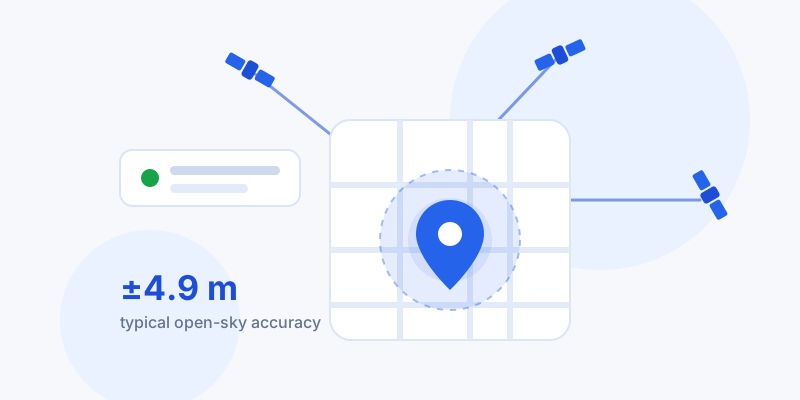
You glance at the blue dot on your map and it lands right on your front step — or sometimes a block away, across the street, or on the wrong floor of a building. So how accurate is phone GPS, really? The short answer: under a clear sky, most modern smartphones place you within about 3-5 meters (10-16 feet). In tougher conditions, that can stretch to 10-20 meters or more. Here's what drives the difference and how to get the tightest fix you can.
Typical phone GPS accuracy
Consumer GPS receivers, including the one in your phone, are designed around a real-world target of roughly 3-5 meters of horizontal accuracy, 95% of the time, with a good view of the sky. Modern phones also listen to more than just the U.S. GPS satellites; they combine multiple "constellations" (GPS, Galileo, GLONASS, BeiDou, QZSS), collectively called GNSS. More satellites in view means a faster, steadier fix.
| Conditions | Typical accuracy |
|---|---|
| Open sky, field or beach | 3-5 m (10-16 ft) |
| Suburban streets, light tree cover | 5-10 m (16-33 ft) |
| Dense city ("urban canyon") | 10-30 m+ (33-100 ft+) |
| Indoors / underground | Very poor; often Wi-Fi based only |
| Newer dual-frequency (L1+L5) phones, open sky | Can approach 1-2 m |
Want to see your own numbers? Open the live device location map and watch the accuracy circle: its radius is the phone's own estimate of how confident it is. A tight circle means a good fix.
What affects your GPS accuracy
GPS works by timing signals from satellites your phone can "see." Anything between you and the sky degrades that. The biggest factors:
- Sky view. Buildings, dense trees, canyon walls, and tunnels block satellites. Your body or a metal-tinted car window can weaken the signal too.
- Multipath in cities. Signals bounce off tall buildings before reaching you, so the phone may place you across the street — the classic urban-canyon error.
- Number of satellites locked. A receiver needs a clear line to at least four satellites; more is better. A cold start (phone just powered on) takes longer to gather them.
- Chipset. Newer dual-frequency (L1 + L5) phones reject reflected signals far better and can reach sub-meter accuracy in the open.
- Assisted GPS (A-GPS). Wi-Fi and cell-tower data help your phone fix faster and fill gaps indoors, though Wi-Fi positioning is coarser than satellite.
How to improve your GPS fix
Most accuracy problems are fixable in a minute or two. Try these in order:
- Step into the open. The single biggest improvement is a clear view of the sky — move away from walls, awnings, and tree cover.
- Turn on high-accuracy / precise location. Let the phone use GPS, Wi-Fi, and mobile networks together rather than GPS alone.
- Give it a few seconds. Accuracy tightens as the phone locks more satellites. Watch the accuracy circle shrink before you trust the reading.
- Calibrate the compass. A figure-eight wave fixes a heading that points the wrong way (this is direction, not position, but it's often the real complaint).
- Toggle and update. Turning location off and on, restarting, or installing OS updates clears stale almanac data.
Reading and using your coordinates
Once you have a good fix, the numbers matter. Check the digits with our latitude and longitude finder; the more decimal places you keep, the more precision you preserve. As a rule of thumb, the fifth decimal place of a decimal-degree value is roughly a meter, so trimming decimals throws away real accuracy.
From there you can put those coordinates to work: convert between decimal, DMS, UTM, and MGRS formats, measure the straight-line distance between two points, or turn a fix into a street address with our reverse geocoding tool. When you just need someone to find you, share a location link instead of reading numbers aloud.
The bottom line
Phone GPS is impressively good, usually accurate to a few meters and getting tighter as dual-frequency chips spread. But it's an estimate, not a survey instrument. Trust the accuracy circle, give the receiver an open sky and a moment to settle, and you'll get the best your hardware can deliver. For anything where precision counts, verify the position before you rely on it.