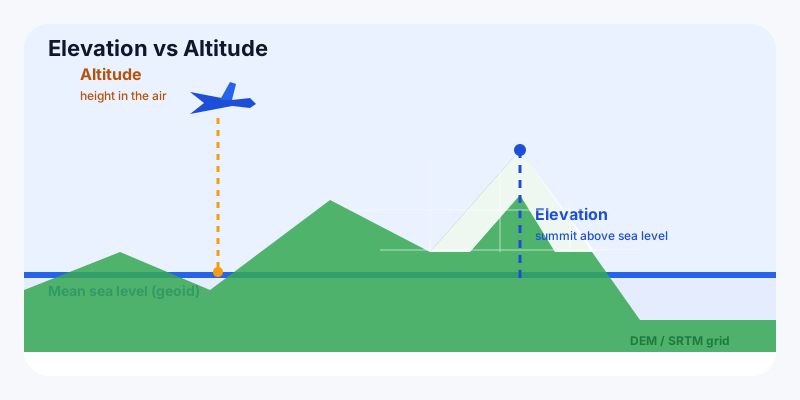
People use "elevation" and "altitude" as if they mean the same thing, and in casual conversation that's fine. But they describe two different ideas, and the gap between them explains why your phone, your watch, and an online map can all report a different number for the exact same spot. Here's what each term really means, how height above sea level is measured, and why GPS altitude is the least trustworthy of the bunch.
Elevation vs altitude: the simple distinction
The cleanest rule of thumb: elevation is about the ground, altitude is about the air.
- Elevation is the height of a fixed point on the Earth's surface above mean sea level (MSL). A mountain summit, a city, or your driveway each has one stable elevation. It doesn't change minute to minute.
- Altitude is the height of an object above a reference surface, usually used for things off the ground. A plane cruises at an altitude; a drone hovers at one. Altitude can change constantly.
A useful test: the elevation of a town is a permanent fact, but the "altitude" your barometric watch shows drifts as the weather changes the air pressure. That's why the two are not interchangeable in any technical setting. If you want the steady, ground-truth number for where you're standing, you can check your elevation above sea level from your current location, or look up the elevation for any address without being there.
How height above sea level is actually measured
"Sea level" itself isn't flat. The reference is mean sea level, modeled by the geoid — a lumpy surface shaped by Earth's gravity that represents where the ocean would settle if it covered the whole planet. Elevation (technically orthometric height) is measured up from that geoid.
Most online elevation comes from a Digital Elevation Model (DEM): a global grid of height values built from satellite and radar surveys. The classic dataset is SRTM (the Shuttle Radar Topography Mission, flown in 2000), which mapped most of the planet at roughly 30-meter spacing. Newer models like Copernicus DEM and ALOS improve on it.
| Source | Typical vertical accuracy | Best for |
|---|---|---|
| SRTM DEM | ~16 m (90% confidence); worse on steep slopes | General lookups, flat to rolling terrain |
| Phone GPS | ±5–15 m or more vertically | Rough, live readings |
| Survey-grade GNSS + geoid model | Centimeters | Engineering, construction |
One important caveat: many global DEMs are surface models. In a forest, radar can register the tree canopy rather than the ground, so a tall stand of trees on flat land may read as a small hill.
Why your GPS altitude is so often wrong
GPS is excellent horizontally but weak vertically: by its geometry, the satellites sit at low angles relative to "up," so small timing errors translate into large height errors. That alone can put you off by 10 meters or more.
There's a second, sneakier problem. A raw GPS fix reports ellipsoidal height — distance above a smooth mathematical model of the Earth — not height above the geoid. The difference between the two surfaces (the geoid undulation) ranges from about +85 m to −105 m around the world. To get a true sea-level elevation, a receiver must subtract a geoid model. Cheap devices skip or approximate this step, which is why your phone's altitude and a map's elevation rarely agree.
For a steadier answer, a DEM-based lookup beats a single GPS reading. If you already have a position, you can pair an elevation lookup with your current latitude and longitude to confirm exactly which point you're querying.
Practical answers to common questions
- "How high am I right now?" Use a DEM lookup rather than your phone's altitude readout; start with your elevation at your current spot.
- "What's the elevation of a place I'm planning to visit?" Search it by address or place name before you go.
- "I have coordinates but they're in the wrong format." Clean them up with a coordinate format converter or turn degrees-minutes-seconds into decimal degrees first.
- "Will it be cold or dark up there?" Higher elevation usually means cooler temperatures and earlier shadows, so check the sunrise and sunset times for the location.
The takeaway
Elevation is the stable height of the ground above sea level; altitude is how high something sits above a reference, and it can move. Both ultimately depend on a model of "sea level," the geoid, which is exactly the step cheap GPS altitude often gets wrong. When you need a reliable number, lean on a DEM-based elevation tool rather than the figure your device flashes on screen.