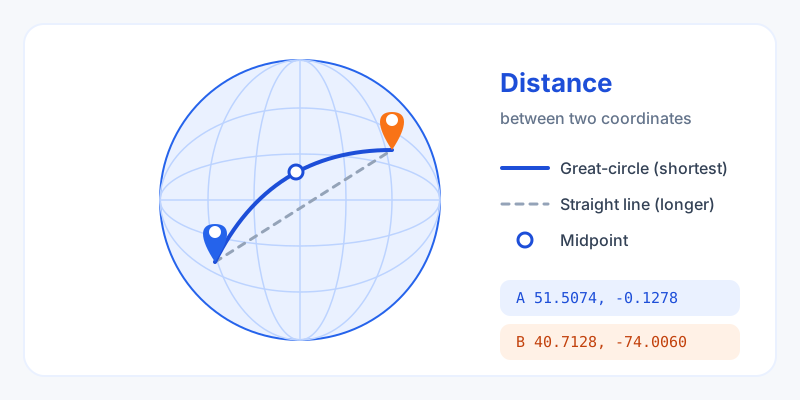
You have two latitude/longitude pairs and a simple-sounding question: how far apart are they? The catch is that the Earth is round, so the answer depends on what kind of "distance" you mean. Here is the method that works for points on a globe, why a ruler on a flat map lies to you, and how to grab the bearing and midpoint while you're at it.
Great-circle distance, not a straight line
The shortest path between two points on a sphere follows a great circle — the largest circle you can draw on the globe that passes through both points. That arc, measured across the curved surface, is the real distance you walk, sail, or fly.
A straight line drawn on a flat Mercator map is a different thing entirely: a rhumb line that holds a constant compass bearing but is usually longer. The gap grows fast over long routes. London to New York is about 4% longer along a rhumb line than the great circle; New York to Beijing is roughly 30% longer. For nearby points the difference is tiny, but for anything continental, "the straight line on my map" is the wrong number.
The fastest way to get a correct figure is to plug both points into a tool that computes great-circle distance between two coordinates; it handles the spherical math so you don't have to.
The haversine formula, in plain terms
Under the hood, most distance tools use the haversine formula, the standard method for geographic distance. The recipe:
- Convert all four values (two latitudes, two longitudes) from degrees to radians by multiplying by π/180.
- Find the differences: Δφ (latitude) and Δλ (longitude).
- Compute
a = sin²(Δφ/2) + cos φ₁ · cos φ₂ · sin²(Δλ/2). - Compute the central angle
c = 2 · arcsin(√a). - Multiply by Earth's radius R (about 6,371 km, or 3,959 miles):
d = R · c.
That's it. The formula treats Earth as a perfect sphere, which is accurate to roughly 0.3% — better than 3 m per kilometre. For survey-grade work you'd reach for Vincenty's or Karney's formulae, which model Earth's slightly squashed (ellipsoidal) shape down to the millimetre. For everyday "how far is it" questions, haversine is plenty.
A handy sanity check: one degree of latitude is always about 69 miles (111 km) apart. If your answer is wildly off that scale, recheck your inputs, and make sure your coordinates are in the same format before you start.
Get your inputs right first
Bad coordinates produce a confident, wrong answer. Two quick rules:
- Use decimal degrees, with signs. South latitudes and west longitudes are negative. If your numbers are in degrees-minutes-seconds, run them through a DMS to decimal degrees converter first, or use a general coordinate format converter to normalise everything.
- Confirm the order. Latitude comes first, then longitude. Swapping them is the single most common mistake.
If you only have an address rather than coordinates, turn it into lat/long with an address-to-coordinates lookup before measuring. Not sure where you are right now? Check your current coordinates and use those as one endpoint.
Bearing and midpoint: the other two questions
Distance is rarely the whole story. Two related values fall out of the same coordinate pair:
| Value | What it tells you | Watch out for |
|---|---|---|
| Bearing | The compass direction from point A to point B, measured clockwise from true north (0°–360°). | Along a great circle the bearing changes continuously, so the "initial bearing" differs from the final one. |
| Midpoint | The point exactly halfway along the great-circle path. | It is not the simple average of the two latitudes and longitudes. |
That midpoint gotcha trips people up constantly. The true midpoint between 35°N 45°E and 35°N 135°E sits near 45°N 90°E, well north of either start point, because the shortest path bows toward the pole. To get it right, use a geographic midpoint calculator that follows the great-circle path rather than averaging numbers by hand.
Putting it together
A reliable workflow: normalise both coordinate pairs to signed decimal degrees, double-check latitude-then-longitude order, then read off distance, bearing, and midpoint from purpose-built tools. When you've found the halfway point — say, for meeting a friend — you can drop it straight into a shareable location link so everyone heads to the same spot. Measure once, share once, no math by hand.