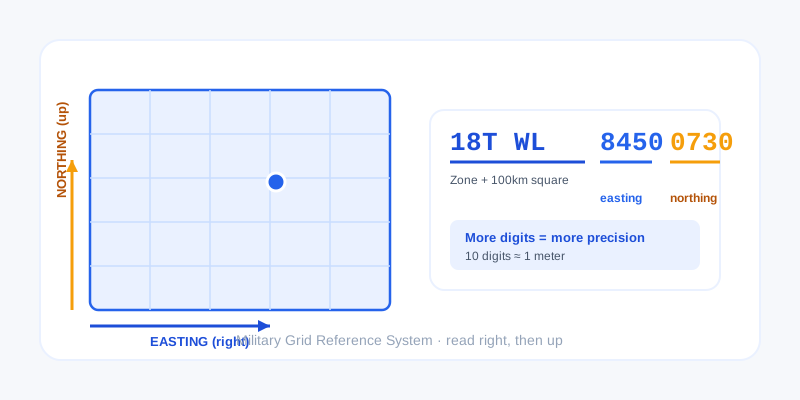
If you have ever seen a position written as 18T WL 84500 07300 instead of plain latitude and longitude, you have met the Military Grid Reference System. MGRS is the standard NATO militaries, FEMA, and search-and-rescue teams use to describe any point on Earth as a short, readable string that is hard to misread over a radio. Here is what MGRS is, how it is structured, how to read it, and how it relates to UTM and the civilian USNG.
What MGRS is (and why it exists)
MGRS is a grid-based way to express a location, built on top of the Universal Transverse Mercator (UTM) projection (and Universal Polar Stereographic near the poles). Instead of two long decimal numbers, it packs a position into a compact alphanumeric reference. The whole system is designed around one practical goal: communicating a precise spot quickly and without ambiguity. Because it uses meters rather than degrees, distances and movements on the ground are easy to reason about.
If you would rather think in plain latitude and longitude, our tool that shows your current coordinates is a friendlier starting point. MGRS is the format you reach for when you need a rugged, field-ready reference.
The structure of an MGRS coordinate
Every MGRS reference is built from three parts read left to right:
- Grid Zone Designator (GZD): a number 1–60 (a 6°-wide UTM zone) plus a latitude band letter (C–X), e.g.
18T. This narrows you to a quadrangle 6° wide by 8° tall. - 100,000-meter square ID: two letters, e.g.
WL, identifying a 100 km × 100 km square inside that zone. - Numeric easting and northing: an even number of digits split in half: the first half is the easting (read right), the second half is the northing (read up).
So 18T WL 84500 07300 means zone 18T, square WL, easting 84500, northing 07300.
How to read it: right, then up
There is one golden rule borrowed from map reading: read right, then up. The easting digits move you across the square from west to east; the northing digits move you from south to north. Split the numeric block in half, take the first half as your horizontal position and the second half as your vertical position, and you have pinpointed the spot.
The number of digits controls precision, and the count is always even:
| Digits | Precision | Roughly |
|---|---|---|
| 2 | 10,000 m | a town |
| 4 | 1,000 m | a neighborhood |
| 6 | 100 m | a city block |
| 8 | 10 m | a house |
| 10 | 1 m | a parking spot |
So 18T WL 845 073 (6 digits) is good to ~100 m, while 18T WL 84500 07300 (10 digits) is good to ~1 m.
MGRS, UTM, and USNG
These three are close relatives. UTM gives you a zone plus a full easting and northing in meters; MGRS takes those same numbers and compresses them using the letter-square shorthand. If you work with UTM figures directly, our latitude/longitude to UTM converter handles that translation.
The United States National Grid (USNG) is essentially MGRS for civilian and emergency use inside the U.S. The grid is identical; the main differences are presentation and datum. USNG usually adds spaces between parts and is published on the NAD 83 datum, while MGRS is typically WGS 84 — a ground difference of about a meter. For everyday WGS 84 work, an MGRS string and a USNG string describe the same place.
Converting to and from MGRS
You rarely build MGRS by hand. To turn a normal location into a grid reference, paste coordinates into our latitude/longitude to MGRS converter and copy the result. Going the other direction, or jumping between formats, is just as quick:
- Switch between decimal degrees, DMS, UTM, and MGRS with the all-in-one coordinate converter.
- Turn a street address into coordinates first using address-to-coordinates lookup, then convert.
- Need to send a spot to someone fast? share your current location as a link instead.
Once you can spot the zone, the square, and the right-then-up digits, MGRS stops looking cryptic — it is just a tidy, meter-based address for anywhere on the planet.